Products and variants
List dimensions, finishes, colours, packaging formats, changeovers and the normal range of acceptable variation.
A useful specification defines the quality decision and production conditions before naming cameras or software. Use this guide to prepare a quotation-ready brief.
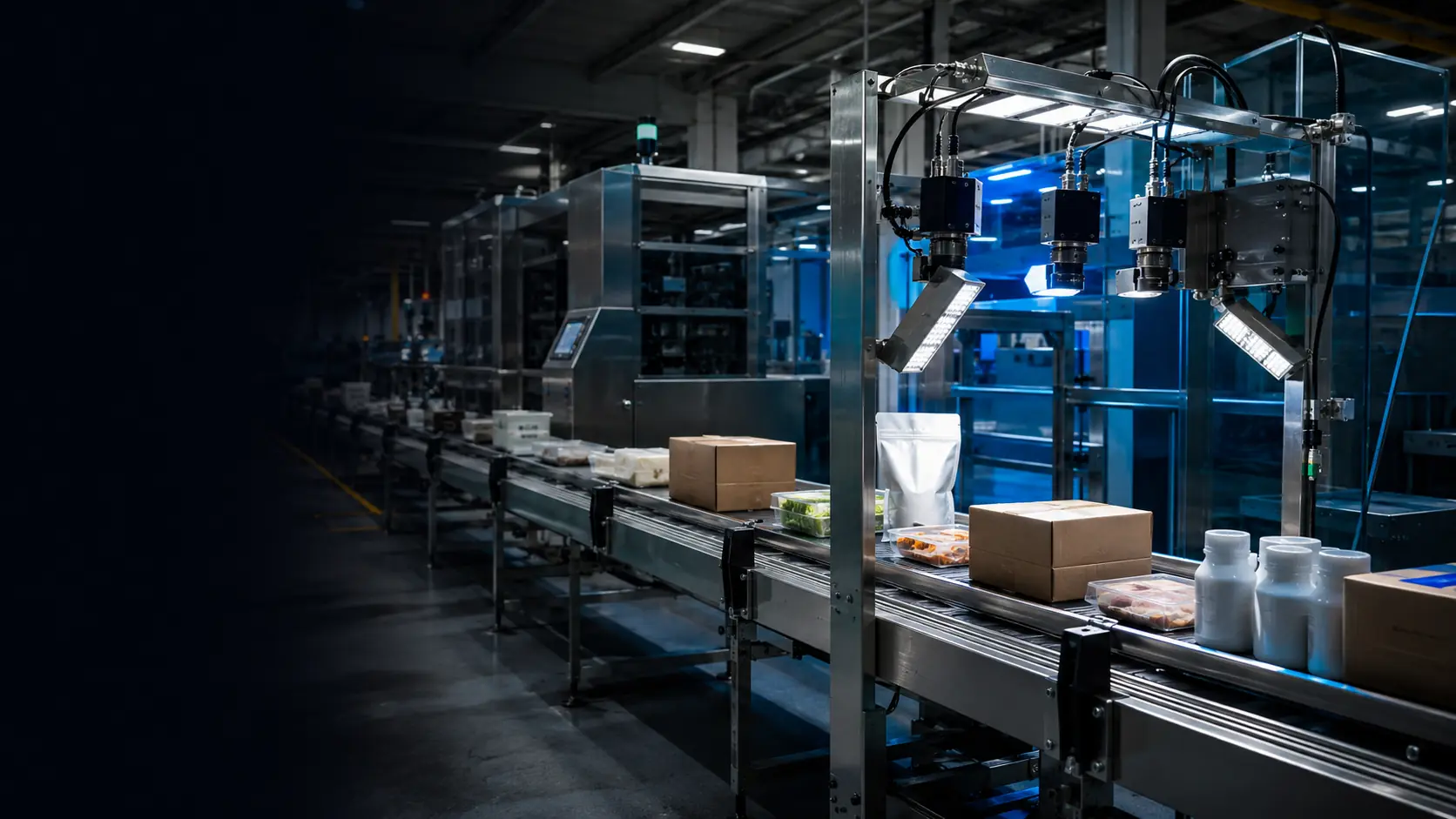 Application-led design Proved against the real product, defect and production conditions.
Define the products and variants, visible defects, acceptance limits, smallest critical feature, line speed, product presentation, environment, required response, records, interfaces and test method. Include representative good, failed and borderline samples so suppliers can prove the optical approach before final design.
Each requirement is tested against representative products, normal variation, line speed and the agreed production response.
List dimensions, finishes, colours, packaging formats, changeovers and the normal range of acceptable variation.
Describe each fault, smallest critical feature, location, frequency, consequence and measurable pass/fail boundary.
State maximum rate, spacing, motion, orientation, conveyor behaviour and any product handling already available.
Document ambient light, cleaning, dust, moisture, vibration, temperature, guarding and maintenance constraints.
Define reject, divert, stop, alarm, guidance, rework or feedback action plus confirmation and fault behaviour.
Specify recipes, users, retained results, interfaces, challenge samples and the conditions for factory and site acceptance.
Camera resolution and software should follow the smallest feature, field of view, speed and decision—not the other way around.
List what must be detected, then agree how misses, false rejects, uncertainty and uninspectable products will be measured.
Handling, optics, controls, safety, data, rejection, documentation, training and support can be as important as the camera.
The useful result is a repeatable decision that operators can understand and the production line can act on.
For each product, state what must pass, what must fail and what may be uncertain.
Collect good, failed, borderline and wrong-variant samples plus line photos or video.
Prove image contrast, feature resolution and method limits under representative conditions.
Agree scope, interfaces, challenge set, speed tests, faults, documentation and handover.
Avoid phrases such as ‘detect all defects’ or ‘100% accurate’. State the fault class, size or tolerance, product range, line condition and test sample. Then define how many samples will be challenged, what result is required and how false rejects and uncertain cases are treated.
Provide representative good products, known failures, borderline examples, every important variant and examples of normal process variation. Label the reason each sample should pass or fail.
Tie performance to the defined product range, defect class, feature size, speed and test method. Detection rate, false rejects and uninspectable conditions should be considered separately.
Only where site standardisation or an existing architecture requires it. Otherwise, define the result, interfaces and constraints so the integrator can select suitable optics and processing.
Use agreed products and seeded faults at representative speed. Challenge recipes, consecutive failures, tracking, reject confirmation, alarms, bypass control, data and recovery from selected faults.
At minimum: product and defect description, dimensions, smallest fault, maximum speed, line photos or drawings, reject requirement, environment, variants and representative images or samples.
Send samples, images, line-speed information and the defects you need to detect. We’ll recommend the right next step.