Caps, pumps, lids, seals and closures
Configured against agreed examples, limits and the required line response.
Presence and absence detection answers a simple production question with engineered reliability: is every required feature there, in the right place, before the product moves on?
Good performance depends on controlling product position, reflections, background contrast and acceptable variation. We design those conditions into the station.
We start with representative products, known defects, acceptable variation, line speed and the required response. That evidence determines the field of view, resolution, optics, processing and mechanical design.
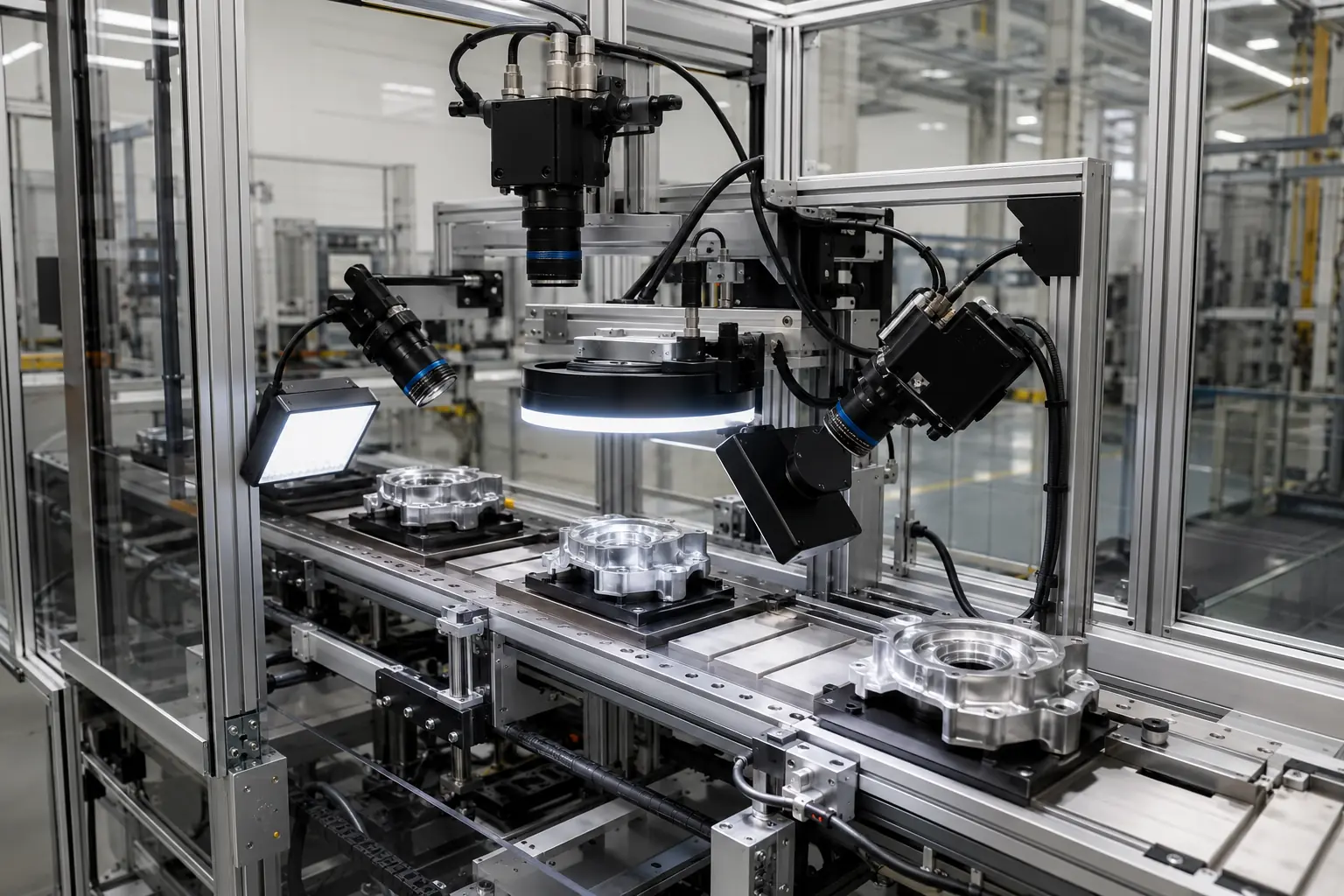 Complete system scope Optics, software, controls and mechanical integration.
Every item below is subject to application proof using the actual product, presentation and production conditions.
Configured against agreed examples, limits and the required line response.
Configured against agreed examples, limits and the required line response.
Configured against agreed examples, limits and the required line response.
Configured against agreed examples, limits and the required line response.
Configured against agreed examples, limits and the required line response.
Configured against agreed examples, limits and the required line response.
Detection is only useful when the result is delivered to the right control, operator or quality record at the right time.
Trigger a stable image using controlled lighting, suitable optics and repeatable product presentation.
Apply proven rules, measurements or trained models with product-specific acceptance limits.
Reject, divert, stop, alarm, guide automation or pass the result to production data systems.
Usually, yes. Inspection tools can check both presence and the allowed position, provided the feature is visible and product presentation is controlled.
The system can signal a reject device, divert route, machine stop or operator alarm according to the agreed controls philosophy.
Often it can, but resolution, viewing angle and lighting must support every feature. Where they do not, a second view is more dependable.
Send us samples, images, line-speed information and the defects you need to detect. We’ll recommend the right next step.