Top, base and side inspection
Configured against agreed examples, limits and the required line response.
Multi-camera systems cover several faces, features or stages of a product so the final decision reflects the complete inspection requirement.
We synchronise triggers, lighting and product tracking, then combine individual results into one product record and one line response.
We start with representative products, known defects, acceptable variation, line speed and the required response. That evidence determines the field of view, resolution, optics, processing and mechanical design.
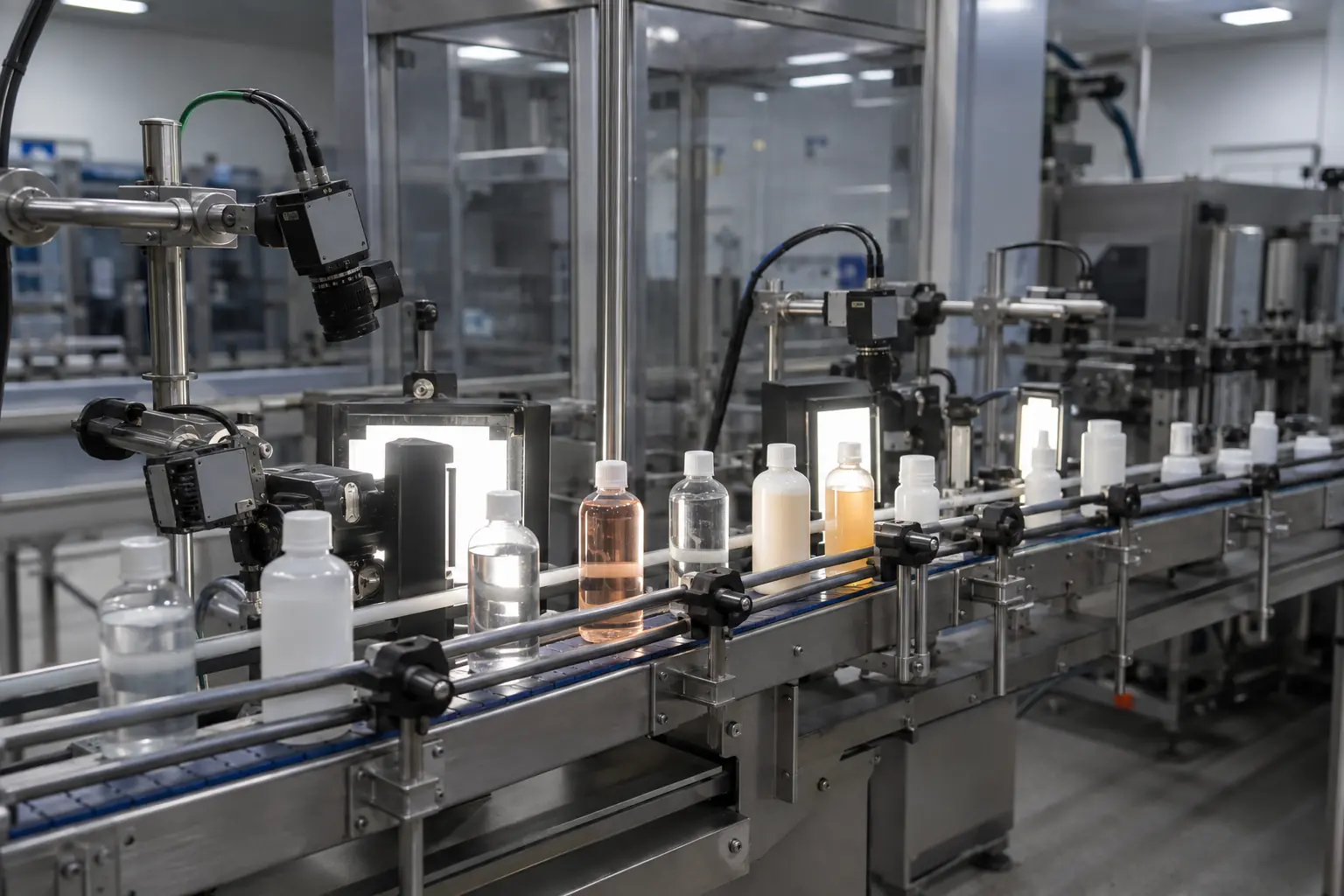 Complete system scope Optics, software, controls and mechanical integration.
Every item below is subject to application proof using the actual product, presentation and production conditions.
Configured against agreed examples, limits and the required line response.
Configured against agreed examples, limits and the required line response.
Configured against agreed examples, limits and the required line response.
Configured against agreed examples, limits and the required line response.
Configured against agreed examples, limits and the required line response.
Configured against agreed examples, limits and the required line response.
Detection is only useful when the result is delivered to the right control, operator or quality record at the right time.
Trigger a stable image using controlled lighting, suitable optics and repeatable product presentation.
Apply proven rules, measurements or trained models with product-specific acceptance limits.
Reject, divert, stop, alarm, guide automation or pass the result to production data systems.
The controls architecture tracks each product or fixture from trigger to decision and on to the reject point.
Yes. Results can be combined across stations when product identity and movement are tracked reliably.
Not always. The choice between networked smart cameras and a central processor depends on synchronisation, processing, data and user-interface requirements.
Send us samples, images, line-speed information and the defects you need to detect. We’ll recommend the right next step.