Complex visible defect classification
Configured against agreed examples, limits and the required line response.
AI vision can classify complex appearance, detect anomalies and separate defects from acceptable natural variation when conventional rules become fragile or overly complicated.
We start with the inspection problem, not the algorithm. Representative image data, clear defect definitions and a controlled optical set-up remain essential to a dependable AI project.
We start with representative products, known defects, acceptable variation, line speed and the required response. That evidence determines the field of view, resolution, optics, processing and mechanical design.
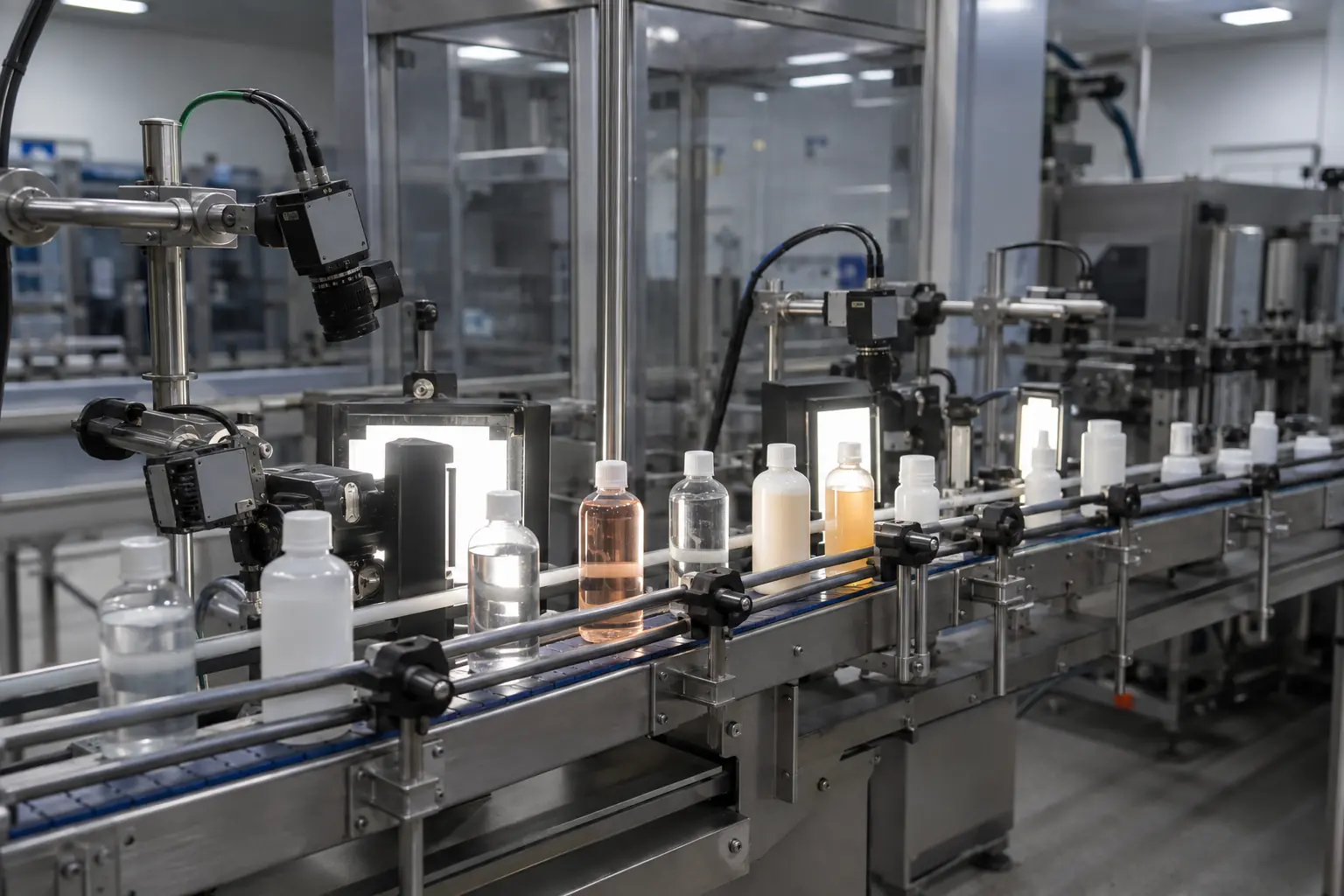 Complete system scope Optics, software, controls and mechanical integration.
Every item below is subject to application proof using the actual product, presentation and production conditions.
Configured against agreed examples, limits and the required line response.
Configured against agreed examples, limits and the required line response.
Configured against agreed examples, limits and the required line response.
Configured against agreed examples, limits and the required line response.
Configured against agreed examples, limits and the required line response.
Configured against agreed examples, limits and the required line response.
Detection is only useful when the result is delivered to the right control, operator or quality record at the right time.
Trigger a stable image using controlled lighting, suitable optics and repeatable product presentation.
Apply proven rules, measurements or trained models with product-specific acceptance limits.
Reject, divert, stop, alarm, guide automation or pass the result to production data systems.
No. Stable images improve every vision system, including AI. Good optics and lighting reduce the data burden and improve repeatability.
It depends on product variation, defect diversity and required performance. We assess the sample set before defining a training and validation plan.
A project can be tested against agreed datasets and acceptance criteria. Regulated applications may also require controlled access, versioning, documentation and change procedures.
An AI inspection model should be assessed on images that were not used to teach or tune it. Repeating the training examples can make performance look stronger than it will be on new production. Agree how training, validation and final test images will be separated before the dataset is assembled.
Build the final test set from representative product variation and the defect classes that matter to the line. Where many images show the same physical item or production event, avoid treating near-duplicates as independent evidence in different sets. Retain the approved expected result and image origin so later comparisons use the same reference. The required quantity depends on the problem and acceptance objective; a universal image count is not a useful promise.
Review missed defects and unnecessary rejections by defect class rather than relying only on one overall accuracy percentage. If the model or acceptance policy changes, record its revision and rerun the agreed assessment. This makes improvement measurable without confusing tuning with proof. Send examples from multiple production runs and identify which defects are rare or difficult to obtain when discussing an AI vision project.
They provide a more credible check of performance on unseen production than repeating the examples used to build or tune the model.
Usually not. Review the relevant defect classes, missed defects and unnecessary rejects against the agreed production requirement.
Define measurable vision acceptance criteria Compare conventional and AI vision requirements
Send us samples, images, line-speed information and the defects you need to detect. We’ll recommend the right next step.