Front/back and top/bottom identification
Configured against agreed examples, limits and the required line response.
Orientation inspection prevents incorrectly presented products reaching labelling, assembly, robotic handling, packing or other downstream operations.
We determine which visible features provide a stable orientation reference, then link the result to reorientation, reject, robot guidance or line-control logic.
We start with representative products, known defects, acceptable variation, line speed and the required response. That evidence determines the field of view, resolution, optics, processing and mechanical design.
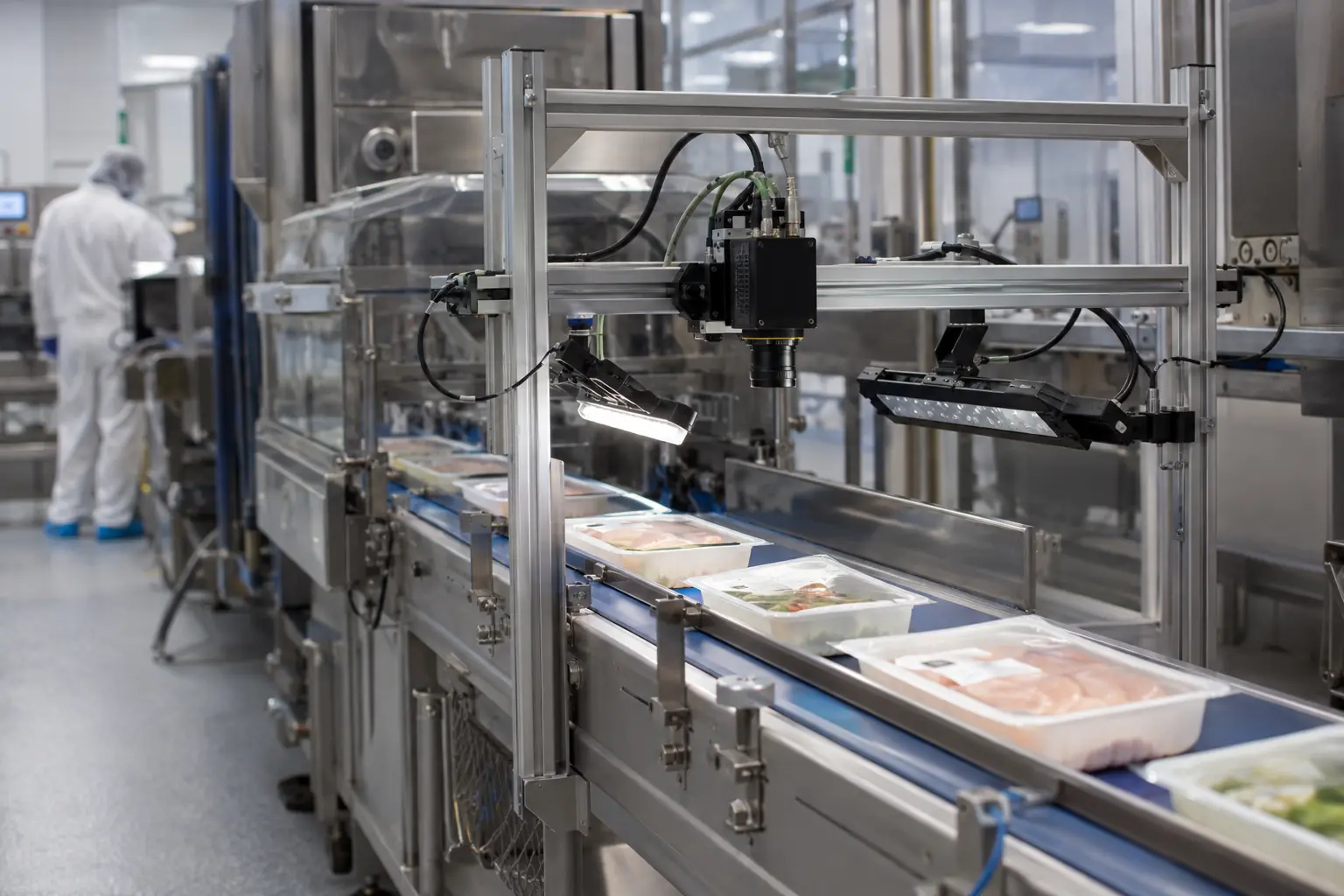 Complete system scope Optics, software, controls and mechanical integration.
Every item below is subject to application proof using the actual product, presentation and production conditions.
Configured against agreed examples, limits and the required line response.
Configured against agreed examples, limits and the required line response.
Configured against agreed examples, limits and the required line response.
Configured against agreed examples, limits and the required line response.
Configured against agreed examples, limits and the required line response.
Configured against agreed examples, limits and the required line response.
Detection is only useful when the result is delivered to the right control, operator or quality record at the right time.
Trigger a stable image using controlled lighting, suitable optics and repeatable product presentation.
Apply proven rules, measurements or trained models with product-specific acceptance limits.
Reject, divert, stop, alarm, guide automation or pass the result to production data systems.
Accuracy depends on image resolution, feature contrast, product movement and calibration. We test the actual product before committing to a tolerance.
Yes, a vision system can provide position and angle data to compatible automation where the application requires guided picking or placement.
We look for a stable distinguishing feature, change the lighting or add another view. If no visible difference exists, another sensing method may be needed.
Send us samples, images, line-speed information and the defects you need to detect. We’ll recommend the right next step.