Resolution and number of views
Small defects, large products and all-round coverage can require higher resolution or multiple cameras.
There is no honest single price for an industrial vision system. A focused smart-camera retrofit and a guarded multi-camera inspection cell have different hardware, engineering, integration and validation requirements.
Installed cost is driven less by the camera brand than by what must be seen, how the product is presented and what the line must do after a decision.
A useful budget must cover the complete production scope: cameras, lenses and lighting; mounts and guarding; product handling; controls and tracking; HMI and recipes; reject hardware; software and data; installation, acceptance testing, training and support. Sample trials are the safest way to reduce uncertainty before a firm specification.
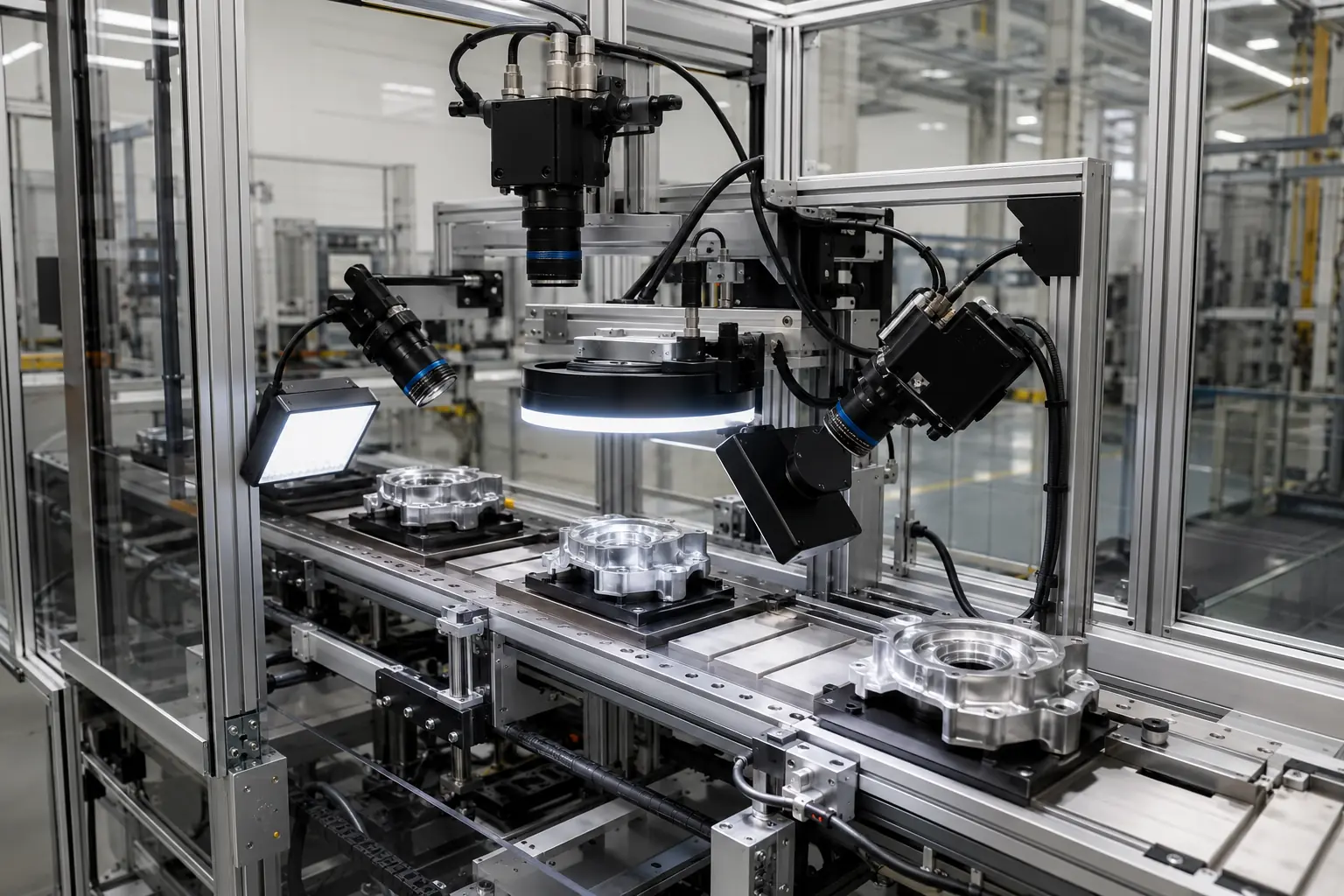 Application-led design Prove the image and line response before final specification.
These factors explain why two camera projects with similar-looking hardware can have very different installed costs.
Small defects, large products and all-round coverage can require higher resolution or multiple cameras.
Reflective, transparent, curved or variable products need more optical engineering than a high-contrast flat part.
Guides, spacing, rotation, triggers and mechanical handling may be needed before a reliable image is possible.
PLC integration, tracking, fail-safe rejection, guarding and reject verification can exceed the camera scope.
Variant management, HMI permissions, image retention, reports and factory-system links add engineering.
Acceptance testing, regulated documentation, training, spares and service requirements affect the project.
The inspection must work with real product variation, line timing and operator responsibilities—not only a laboratory image.
Quantify manual inspection, scrap, rework, complaints, downtime or traceability needs.
Provide every product variant, good samples, known defects and the smallest critical fault.
Share line speed, spacing, drawings, controls, environment, available space and reject location.
Define detection, false-reject, challenge-sample and failure-response requirements before purchase.
Estimate the annual cost that a proven system can realistically influence: inspection labour, scrap and rework, escaped-defect cost, production disruption and avoidable claims. Subtract annual support and operating cost. Comparing installed cost with that annual net benefit gives a clearer payback discussion than camera price alone.
The production result also depends on optics, lighting, mechanics, controls, product tracking, reject handling, safety, software, installation and validation. Those elements vary more than the camera price.
It can be for a focused inspection with limited views and data requirements. A PC platform may be more appropriate for many cameras, complex processing, extensive data or coordinated inspection stages.
It may reuse an existing conveyor and controls, but constrained access, short reject distances or unsuitable product handling can add engineering. A site survey is needed.
Look for a defined inspection scope, optical hardware, mechanics, controls, safety, reject handling, software, data, installation, acceptance testing, documentation, training, warranty and support assumptions.
Start with representative sample trials, agree measurable acceptance criteria and identify product-handling or line-integration constraints before freezing the design.
Send us samples, images, line-speed information and the defects you need to detect. We’ll recommend the right next step.