Caps and closures
Confirm presence, position, height, colour, skew or visible tamper-band condition.
Automate visible checks on bottles, cans, jars, trays, pouches, cartons and multipacks. Each system is engineered around the package, line speed, viewing access and required production response.
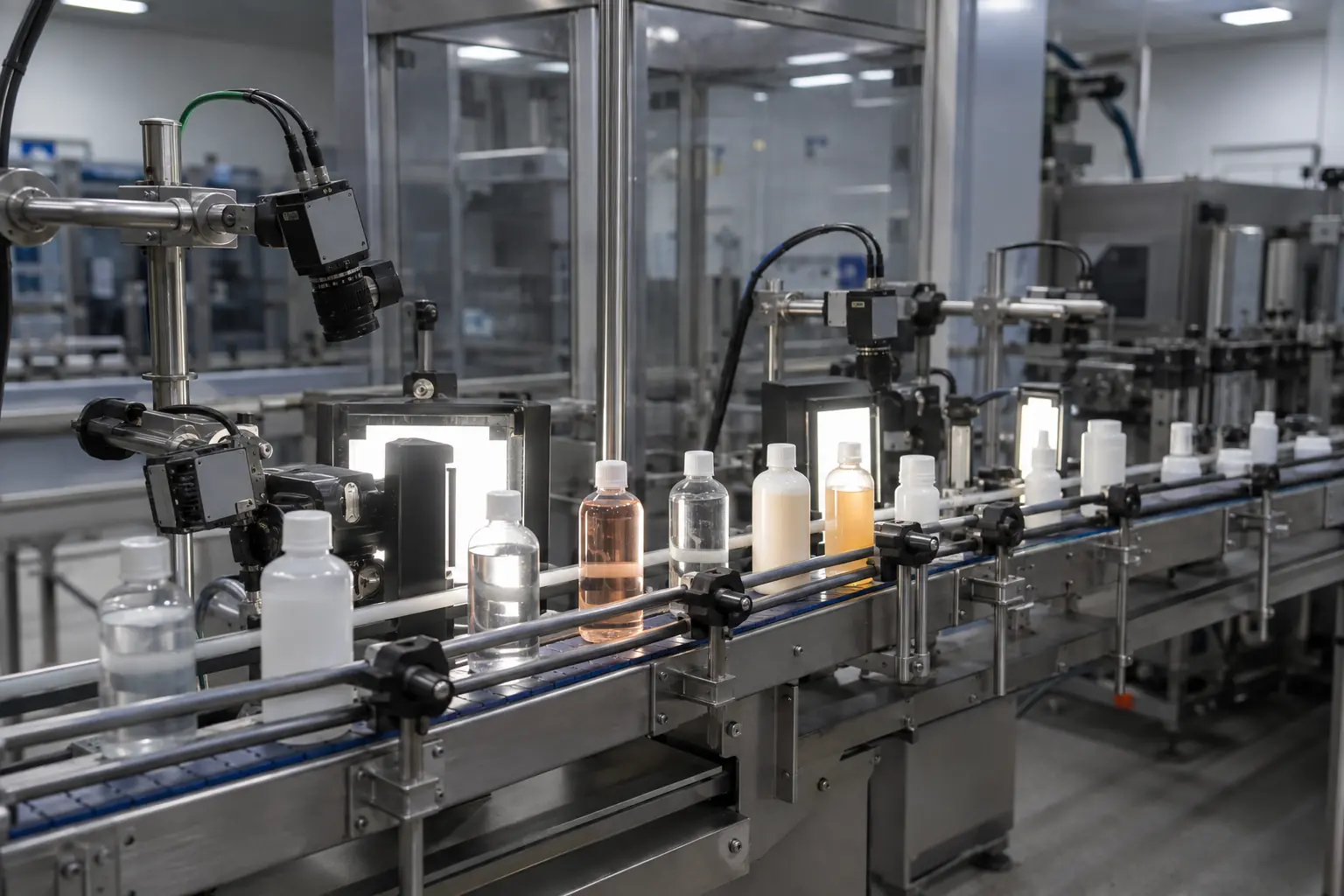
Packaging vision inspection uses industrial cameras to check visible pack features automatically while products move through production.
A complete system may inspect cap and closure presence, fill level, label placement, printed codes, seal regions, container damage or pack completeness. The camera result must be linked to product tracking and a proven reject, divert, alarm or stop response so the failed pack is handled correctly.
 Application-led design Prove the image and line response before final specification.
Visible defects are assessed with representative packs under production-like conditions. Leak detection and seal integrity may need additional sensing where a camera cannot prove the fault.
Confirm presence, position, height, colour, skew or visible tamper-band condition.
Measure a visible liquid or product level where the container and optical contrast allow.
Check for visible contamination, folds, damage or missing material in an agreed seal area.
Combine package checks with label presence, position, OCR, OCV and code reading.
Confirm expected products, components, leaflets, lids or grouped items are present.
Detect agreed visible dents, deformation, damage, colour or orientation faults.
The inspection must work with real product variation, line timing and operator responsibilities—not only a laboratory image.
Prioritise the packaging faults that create waste, complaints, recalls or retailer rejection.
Test product handling, reflections, curvature, speed and acceptable pack variation.
Engineer camera positions, guarding, tracking, controls, HMI and reject handling.
Challenge the system with known faults and agreed acceptance criteria at production speed.
A top camera can prove a lid but cannot see every side of a cylindrical label. A side view may measure fill level but miss a base code. The number of views should follow the inspection evidence: target feature size, required resolution, package geometry and the time available for a decision.
Often, yes. A retrofit survey checks viewing access, product control, available line signals, guarding, reject space and the distance between inspection and rejection.
Yes when suitable views are available. Different features may require separate cameras or lighting because cap geometry and liquid level need different optical conditions.
Vision can detect agreed visible faults such as contamination, folds or missing material in a seal region. It does not automatically prove seal strength or leak tightness, so other tests may still be required.
Yes. Multiple cameras, line-scan imaging, mirrors or controlled product rotation can provide circumferential coverage. The right method depends on speed, resolution and container handling.
Yes, subject to the selected platform, data volume and retention policy. Image storage and production-data integration should be specified at the start.
Send us samples, images, line-speed information and the defects you need to detect. We’ll recommend the right next step.